
Confederates Don't Deserve Monuments
Allow Me to Elaborate #3

After an embarrassingly long break, I’m back!
My New Years resolution is to actually adhere to the two-articles-a-month goal I set for myself. I have a lot in the pipeline, so stay tuned.
In regard to this particular piece, I’d like to STRONGLY recommend “Robert E. Lee and Me” by Ty Seidule. A lot of the information I based this piece on comes from that book. It’s a very compelling read. Seidule is a retired army brigadier general and a professor emeritus of history at West Point. His expertise and personal experience make him a much better advocate for the argument I make below than I ever could be. Do yourself a favor and pick up a copy of his book.
Last month, the long-awaited statue of civil rights figure Barbara Rose Johns was unveiled in the Capitol. Johns’ likeness replaced that of Confederate General Robert E. Lee, which was removed in 2020, as one of the two statues that represent Virginia in the National Statuary Hall (the other is of George Washington). After the news broke, my X timeline was filled with posts about how the liberals/leftists/democrats were attempting to “erase” Southern/Virginian heritage. A post by The Blaze called the Johns’ statue a “DEI statue.”
Such reactions are both logically misguided and historically ignorant. Anyone with any sense, regardless of race or political party, should see the new Johns statue as a positive development. In fact, every morally sane person should be in favor of tearing down every last Confederate monument in our great nation.
Allow me to elaborate.
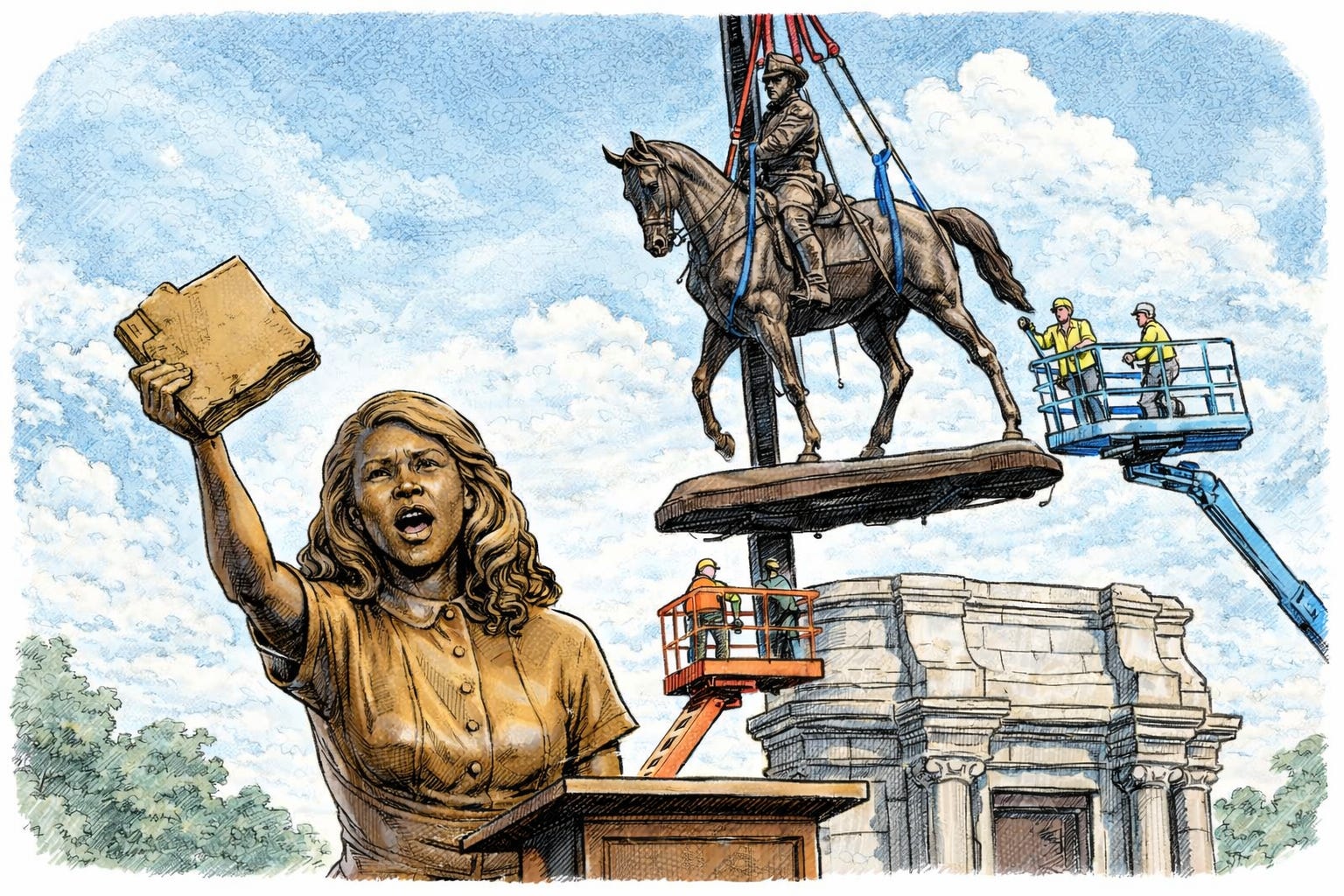
As far as I can tell, the outrage about the Johns statue comes from two places; a fervent disdain for anything even remotely associated with “wokeness” or DEI, and an equally fervent belief in the Lost Cause myth. These two factors are warping people’s minds so intensely that they reject an obvious truth: Robert E. Lee does not deserve to be honored in our nation’s Capitol, nor does any other Confederate.
This should not be considered a woke position, even if it happens to be one that left-wing identitarians overwhelmingly and emphatically hold.
For context, let me just emphasize how incredibly not woke I am. I’m a veteran, staunch patriot, and a registered independent, as well as a strong believer in the virtues of colorblindness, capitalism, and a well-funded police force. I’m also a white Southerner. Although I was born in Michigan, I was raised in Leesburg, Virginia, a town that is both named after the Lee family and located less than 40 miles upriver from Robert’s own hometown of Arlington. I joined the Air Force out of Richmond, and took the ASVAB (the military’s basic aptitude test) at Fort Lee. I currently live in Austin, Texas, where I’ve just returned after visiting my father’s side of the family in Hot Springs, Arkansas. In short, I’m not exactly the poster child for the BLM movement.
When I argue that there should be no Confederate monuments, I’m not doing so from a left-wing, anti-white, or anti-west perspective. I’m doing so from a patriotic, classical liberal perspective.
The Guilt by Association Fallacy
Sure, basically all of the most annoying woke people you could think of are adamantly in favor of tearing down Confederate statues, as well as renaming all military installations, schools, and other institutions currently named after Confederate figures, but that shouldn’t matter. Assuming a position is wrong because a person or group you dislike supports it is an obvious logical error. It even has a name: the guilt by association fallacy.
It’s entirely okay to disagree with someone on most things, while still agreeing with them on a few others. In this age of brain-warping culture wars, a lot of people seem to have forgotten it’s possible to do this without betraying your convictions. Agreeing with someone on one thing, or even a handful of things, doesn’t mean you automatically subscribe to their entire worldview.
Even a broken clock is right twice a day, after all.
Here’s a cliché but useful example. Hitler hated smoking so much that he championed anti-smoking campaigns on the grounds that it would damage the health of the so-called “chosen folk.” In fact, during the Third Reich German scientists were the first to link smoking tobacco to cancer. I happen to agree that smoking is unhealthy, does that make me a Nazi? Should we promote smoking simply because one of history’s most horrible tyrants opposed it? Of course not.
The Nazis were right about the negative effects of smoking and catastrophically wrong about racial hierarchy, global jewish conspiracies, and a whole host of other very important issues. Similarly, the typical wokester is mostly correct about the issue of Confederate statues and (in my opinion, of course) mostly wrong about questions relating to race, policing, economics, American culture, and much more.
If you are reflexively against anything your political opponents support, then you’re effectively allowing them to decide your politics. Don’t let them do that. Think for yourself.
Lost Cause Lee Vs. The Real Lee
The idea that Confederate rebellion was about states’ rights and the Southern way of life, rather than preserving the institution of race-based slavery, is simply false. The idea that the antebellum South was a kind and genteel society in which most slaves were content to serve their loving masters is laughably false.
These foundational claims of the Lost Cause Myth have been thoroughly debunked by historians, yet many still seem to believe them. As a result, the removal of Confederate memorials strikes a lot of people as crass, ahistorical presentism. The truth is, however, that such actions are a correction of the record.
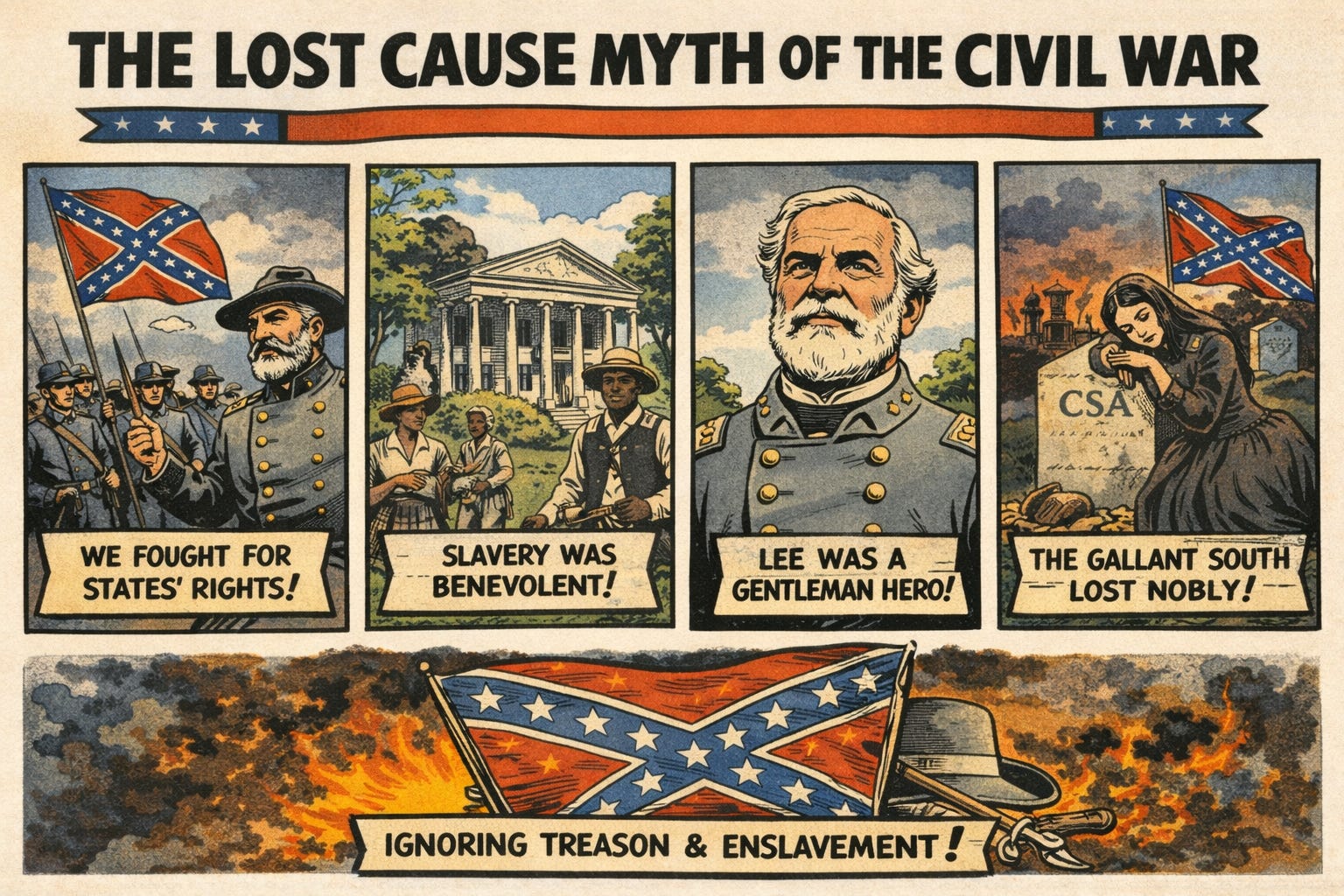
Lee, for example, is seen by many as a brilliant military commander whose love for his home state of Virginia was so great that he simply had to fight for the Confederacy. His decision was a tortured one, but no self-respecting Virginia military man of his time would choose the Union.
It’s also widely believed that Lee was not fighting for slavery. Much like his fellow rebels, he was fighting for his state and his way of life. Besides, he treated his slaves well and even freed many of them.
These are just a few of the more common beliefs people have about Lee, and they are all either exaggerated, taken out of context, or flat-out incorrect.
The idea that Lee had no choice but to fight for Virginia is a very difficult one to defend. Lee had been a commissioned officer in the U.S. Army for decades by the start of the Civil War in 1861. He graduated from West Point second in his class, served with distinction in the Mexican-American War, and eventually achieved the rank of colonel (an especially impressive accomplishment in those times). One would think Lee should have felt some amount of loyalty to the army that gave him a career.
In fact, Lee was the only one of eight regular army colonels from Virginia who betrayed his country. The rest fought for the Union. In other words, Lee was uniquely treacherous when compared to other Virginian officers of his rank.
Perhaps the most pernicious falsehood embodied by what one might call the Lost Cause Lee (as opposed to the actual, historical Lee) is that he was a kind master who was good to his slaves, and who cared for the institution of slavery so little that he eventually freed them. Neither of these claims are borne out by the evidence.
Lee most certainly did use brutal corporal punishment to control his slaves. He also tore slave families apart by selling individuals with spouses and/or children to other slavers.
While it is true that Lee freed many of his slaves, he only did so because he was legally obligated to. The slaves he freed were those he inherited from his father-in-law, who had stipulated in his will that they were to be freed. Even with this legal imperative, Lee postponed their freedom until the last possible moment.
Make no mistake, Lee was perfectly happy to own slaves, enthusiastically supported the institution of slavery, and believed in white-dominant racial hierarchy until the day he died.
The only way in which Lost Cause Lee and the real Lee align is on his prowess as a military commander, though even that is often exaggerated. While he was a truly brilliant tactical and strategic thinker, he still made a number of errors as commander of the Army of Northern Virginia. Some of those errors could be argued to have cost him, and by extension the entire Confederacy, a Southern victory.
More importantly, the fact that Lee was as good as he was only led to more death and destruction. Had he not been so skilled a commander, fewer American soldiers would have died, the war likely would have ended sooner, and the South would not have faced as much economic ruin. He used his talent for war to kill loyal American soldiers, and he was exceptionally good at it.
As I stated above, I’m a veteran and a patriot. I don’t think killing thousands of American service members in a slavers rebellion warrants being honored in our nation’s Capitol. Do you?
The Truly Deserving
Unlike Robert E. Lee, Barbara Rose Johns actually did some good for her country. In 1951, she led a student walkout protesting the inadequate and unequal conditions at her all-black high school in Farmville, VA. That got the attention of the NAACP, whose lawyers filed a lawsuit that would eventually be used as one of the five cases in Brown v. Board of Education. In other words, Barbara Rose Johns helped end school segregation.
Unlike Johns, Lee was no hero, nor was any other Confederate leader. Those men betrayed their country, fought a legally and morally unjustifiable rebellion that got hundreds of thousands of Americans killed, devastated the Southern economy, and lost. You don’t need to be a woke leftist to understand that such men should not be memorialized with statues.
There is no shortage of great, loyal Americans who, like Johns, are more deserving than Lee and his ilk. Why not memorialize them?
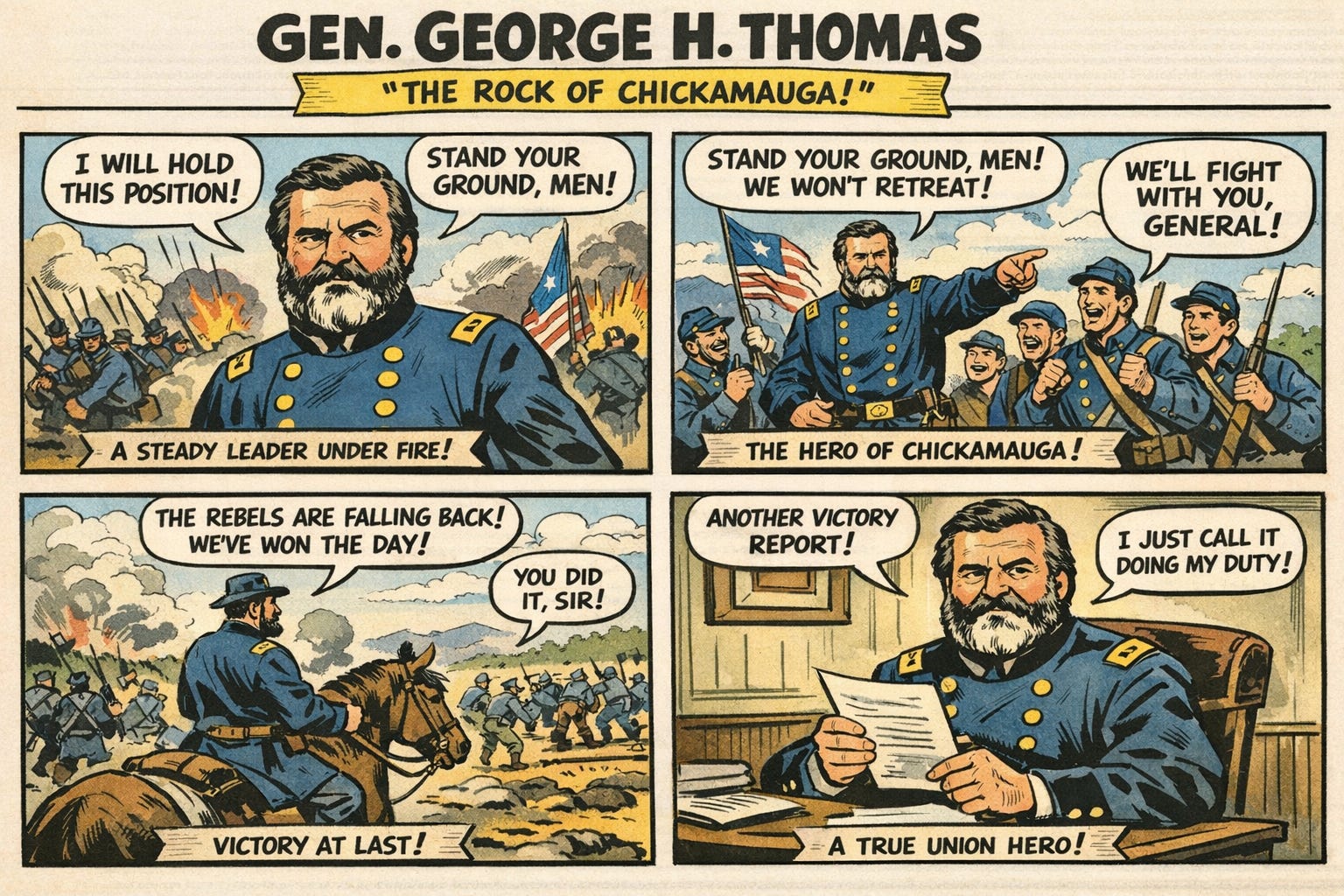
For example, I would love to see statues of Virginia’s loyal officers replace those of the Confederates that once dominated Monument Avenue in Richmond. I might suggest General George Henry Thomas, a Virginian Unionist whose leadership at the Battle of Chickamauga saved the Army of the Cumberland and earned him the nickname “The Rock of Chickamauga.” General Thomas also crushed a Confederate army under General John Bell Hood, helping to secure victory in the Western theater. After the war, Thomas fought to put down the Ku Klux Klan.
Let’s put a giant statue of him on the junction of Monument and Allen.
It’s Not Woke to Support the Removal of Confederate Monuments
Replacing Robert E. Lee with Barbara Rose Johns does not equate to the erasure of Southern history or Virginian culture. It is a triumph of moral clarity. Lee can and should still be studied in school as the complex figure that he was. I’m not advocating for a complete demonization of him or the other Confederates, just an acknowledgment of the fact that they were unambiguously on the wrong side of history, and thus should not be lionized.
Virginia made the right choice in honoring Johns over Lee, a choice any American should be able to understand. It’s not woke to support the removal of Confederate monuments, nor is it an example of presentism. It’s patriotic.
A recovery of constructive patriotism is vital if we want to keep our democracy and maintain a functional sense of self as a people. Clay lays out a good civically patriotic view here. I will be buying the book!